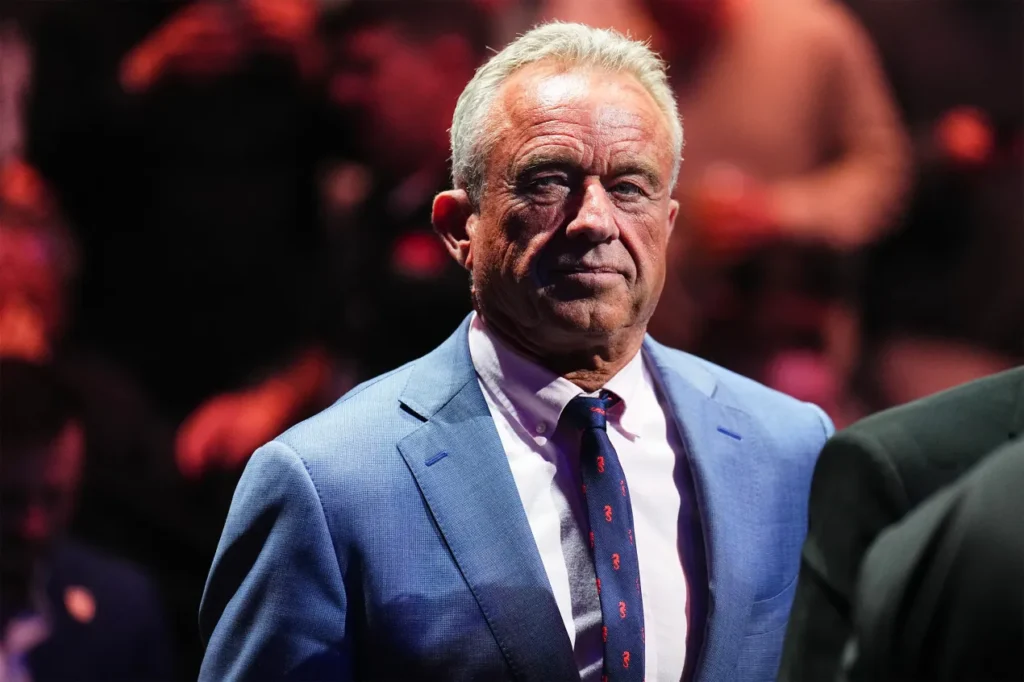
After President-elect Donald Trump nominated Robert F. Kennedy Jr., an anti-vaccine activist, as his top health official, experts warn of a resurgence of preventable diseases. (Chris Unger/Zuffa LLC via Getty Images)
Robert F. Kennedy Jr. has emerged as one of the most controversial figures in American politics and public health. Known for his long-standing involvement in the anti-vaccine movement, his outspoken criticism of COVID-19 policies, and his unexpected path into the White House, RFK Jr. stands at the crossroads of conspiracy theories, political polarization, and genuine public debate.
Update — Nov 21, 2925
At a recent event this week, the health secretary speculated that aluminum in vaccines is causing children’s peanut allergies.
Read more – Gizmodo.com RFK Jr says vaccines may cause peanut allergy
Update — Sept 22, 2025
RFK Jr., now serving as HHS Secretary, announced that acetaminophen (Tylenol) use in pregnancy may increase autism risk — a claim experts describe as disputed and unproven.
RFK Jr.: From Environmental Advocate to Health Secretary – A Comprehensive Analysis
Robert F. Kennedy Jr.‘s path to becoming Secretary of Health and Human Services represents one of the most dramatic ideological journeys in modern American politics. Born into the nation’s most prominent political dynasty on January 17, 1954, Kennedy was shaped by both extraordinary privilege and profound trauma that would influence his worldview for decades to come.
The Making of an Outsider
Kennedy’s formative years were marked by the weight of family legacy and personal tragedy. As the son of Attorney General and Senator Robert F. Kennedy and nephew of President John F. Kennedy, he grew up with intense public scrutiny and expectations of public service. However, the assassination of his father when Kennedy was just 14 years old in 1968 introduced him to conspiracy theories and skepticism about official narratives that would resurface throughout his career.
Despite attending elite institutions like Millfield School in England, Harvard University, and the University of Virginia Law School, Kennedy struggled with personal demons. His battle with heroin addiction in his youth, culminating in a 1983 arrest for possession, became a defining experience. His successful rehabilitation and recovery not only shaped his views on personal agency versus medical intervention but also fostered a deep skepticism of the pharmaceutical industry that would later evolve into broader anti-establishment positions.
Environmental Champion
Kennedy’s professional career began in environmental law, where he achieved legitimate and significant victories. Joining the Riverkeeper organization in 1984 as a staff attorney, he led successful campaigns to clean up the Hudson River and prosecuted polluting corporations under the Clean Water Act. Over the following decades, he won hundreds of millions in settlements from polluters, helped restore fish populations, and protected drinking water for millions of New Yorkers.
These early successes established Kennedy as an effective environmental attorney and compelling public speaker. His work during this period was widely praised and built his reputation as someone willing to take on powerful corporate interests on behalf of environmental justice. However, this David versus Goliath narrative also began to shape a broader worldview that viewed corporations as inherently harmful and government agencies as potentially captured by industry interests.
The Pivot to Vaccine Skepticism
Kennedy’s entry into anti-vaccine activism began in 2005 with the publication of “Deadly Immunity” in Rolling Stone and Salon. The article alleged a government cover-up of vaccine-autism links through thimerosal, a mercury-containing preservative used in some vaccines. Kennedy claimed that government agencies knew vaccines caused autism but manipulated data to hide the dangers, prioritizing pharmaceutical company profits over children’s health.
The scientific response was swift and comprehensive. Multiple large-scale studies found no link between thimerosal and autism, and autism rates continued rising even after thimerosal was removed from most childhood vaccines. The scientific consensus firmly rejected the mercury-autism connection, leading Rolling Stone and Salon to later correct and retract portions of the article.
However, Kennedy’s personal conviction remained unshaken. Influenced by families claiming vaccine injuries to their children, he applied his environmental lawyer mindset to the pharmaceutical industry, seeing parallels between corporate pollution and what he viewed as vaccine “contamination.” This genuine belief that he was protecting children from harm became the driving force behind his expanding activism.
Building an Anti-Vaccine Movement
In 2016, Kennedy founded what would become Children’s Health Defense (originally called the World Mercury Project), an organization dedicated to “defending children’s health” from environmental toxins and what it characterized as unsafe vaccines. The organization’s mission expanded from funding research critical of vaccine safety to mounting legal challenges against vaccine mandates and conducting public education campaigns about alleged vaccine risks.
The organization’s growth was substantial, with revenue increasing from $1.1 million in 2016 to $6.8 million in 2019, with significant additional growth during the COVID-19 pandemic. Kennedy hired other prominent vaccine skeptics, creating what critics described as an echo chamber of vaccine-critical viewpoints while developing sophisticated media and communication operations.
Kennedy’s arguments evolved from his initial focus on thimerosal and mercury to broader questioning of vaccine safety generally. He began opposing vaccine mandates on freedom grounds and eventually questioned the need for most childhood vaccines. His key themes included claims that vaccines cause autism and other developmental disorders, that pharmaceutical companies suppress safety data, and that government agencies have been captured by industry interests.
The COVID-19 Turning Point
The COVID-19 pandemic marked a significant escalation in Kennedy’s anti-establishment activism. From the early days of the pandemic, he questioned the severity of the COVID-19 threat, criticized lockdown measures as government overreach, and promoted alternative treatments over vaccines. He became a vocal advocate for hydroxychloroquine as a COVID-19 treatment, aligning with then-President Trump’s promotion of the drug despite mixed research results.
Kennedy characterized the development of COVID-19 vaccines as dangerously rushed, questioning safety testing and approval processes. He was particularly critical of mRNA technology, characterizing mRNA vaccines as experimental gene therapy and promoting fears about DNA alteration and genetic modification. His organization became a major source of what health authorities characterized as vaccine misinformation, coordinating with other anti-vaccine organizations globally.
This period also saw Kennedy face restrictions on major social media platforms. Instagram banned him for spreading vaccine misinformation in 2021, while Facebook and YouTube limited the distribution of his content. Kennedy responded by claiming these bans proved he was telling inconvenient truths and arguing that his First Amendment rights were being violated. He used these restrictions as evidence of a conspiracy to silence him, moving to alternative platforms and direct communication methods.
Presidential Ambitions and Political Evolution
Kennedy’s 2024 presidential campaign represented an attempt to translate his activism into political power. Initially seeking the Democratic nomination to challenge President Biden, his campaign focused on vaccine skepticism, corporate criticism, and anti-establishment themes. When he struggled to gain traction within the Democratic Party, he left to run as an independent candidate, positioning his campaign as an alternative to both major parties.
The campaign was marked by numerous controversies. Beyond his vaccine and health positions, Kennedy made statements that appeared to endorse various conspiracy theories, questioned the 9/11 official narrative, and made comments about WiFi and 5G health effects. His controversial comparisons between vaccine policies and historical oppression, including comments about Anne Frank that sparked significant backlash, drew criticism from Jewish organizations and Holocaust survivors.
Despite consistent single-digit polling nationally, Kennedy maintained substantial social media following and appeared frequently on podcasts and alternative media platforms. His appeal was primarily to audiences skeptical of mainstream media and those seeking an anti-establishment alternative, though he struggled to convert name recognition into broad electoral support.
Ascension to Power
Following Trump’s 2024 election victory, Kennedy’s nomination as Secretary of Health and Human Services represented a dramatic shift in federal health policy. The selection faced intense scrutiny during Senate confirmation hearings, with medical and public health organizations expressing strong opposition while supporters argued for reform of what they characterized as “captured” health agencies.
Kennedy’s confirmation along party lines with Republican support marked the beginning of significant changes in federal health policy. Career scientists and health officials expressed concerns about the leadership change, while the international health community watched nervously for policy shifts. The pharmaceutical industry and medical associations prepared for regulatory changes, while public health experts warned of potential consequences.
Policy Implementation and Institutional Change
As HHS Secretary, Kennedy implemented sweeping changes to vaccine policy and agency operations. He rescinded emergency use authorizations for COVID-19 vaccines, implemented physician consultation requirements for all vaccinations, and removed routine recommendations for healthy populations. He restructured advisory committees to include vaccine-skeptical voices and initiated comprehensive reviews of existing vaccine safety data and recommendations.
Kennedy’s approach to agency restructuring involved appointing allies to key positions throughout health agencies and shifting funding away from mRNA vaccine development toward alternative treatment research. His administration promoted natural immunity and lifestyle medicine approaches while reducing emphasis on pharmaceutical interventions, representing a fundamental shift in federal health policy priorities.
The Broader Conspiracy Worldview
Kennedy’s positions on vaccines exist within a broader conspiracy worldview that sees systematic collusion between government and corporate interests. He believes government agencies have been captured by corporate interests, with regulatory processes corrupted by financial incentives and democratic institutions undermined by corporate power. This worldview extends beyond health policy to encompass skepticism about official narratives of major historical events and suggestions of cover-ups and conspiracies in various contexts.
Kennedy’s information ecosystem relies heavily on alternative media networks and vaccine-skeptical sources, while dismissing mainstream scientific consensus as compromised. This approach involves highlighting studies that support predetermined positions while dismissing contradictory evidence as flawed or corrupted, applying different standards of evidence to different sources depending on whether they confirm existing beliefs.
Impact and Consequences
The measurable impacts of Kennedy’s activism and policies have been significant. Children’s Health Defense has been linked to increased vaccine hesitancy, with school vaccination rates declining in areas with high CHD activity. Measles outbreaks have been correlated with anti-vaccine activism, and COVID-19 vaccination rates were affected by Kennedy’s messaging. His influence has extended internationally, contributing to declining confidence in public health measures globally.
Healthcare providers report increased vaccine hesitancy among patients, requiring more time to address concerns and misinformation. Resources have been diverted to counter misinformation campaigns, creating strain on public health communication efforts. The politicization of vaccine issues has created unusual political coalitions while contributing to the erosion of bipartisan consensus on public health.
Kennedy’s supporter base includes parents concerned about vaccine safety, individuals with personal or family histories of adverse reactions, libertarians opposing government health mandates, and environmental activists suspicious of the pharmaceutical industry. These supporters are motivated by genuine concerns for children’s health, desires for medical freedom, skepticism of corporate influence, and attraction to anti-establishment messaging.
Critics include the medical and scientific community, public health officials, and some political figures who warn of disease outbreak risks and document vaccine safety and effectiveness. The tension between these perspectives reflects broader societal debates about the balance between individual freedom and collective responsibility, the role of expertise in democratic governance, and the challenge of maintaining institutional trust in an era of widespread skepticism.
September 22, 2025 Announcement and Reactions
On September 22, 2025, President Donald J. Trump and Health and Human Services Secretary Robert F. Kennedy Jr. made a public announcement at the White House regarding proposed links between acetaminophen (Tylenol) use during pregnancy and an elevated risk of autism spectrum disorder (ASD). As part of the announcement, they said the FDA would issue guidance for physicians to inform patients about this potential risk, and update warning labels on acetaminophen to reflect concern. They also proposed that pregnant women limit acetaminophen use unless medically necessary (for example, in cases of high or prolonged fever). Alongside that, the administration advanced plans to expand approval of leucovorin (a folinic acid compound) for addressing certain speech-related deficits in children with ASD who have cerebral folate deficiency.
Scientific and Public Health Reactions
- Experts immediately noted that while there are observational studies that suggest associations between prenatal acetaminophen exposure and neurodevelopmental outcomes (including language delays, ASD, ADHD), these studies do not establish causation. Scientific American Nature
- In particular, a 2025 systematic review using the Navigation Guide methodology found that most higher-quality studies report positive associations of acetaminophen exposure with neurodevelopmental disorders, including ASD, though there is substantial heterogeneity and risk of bias in many studies. BioMed Central
- On the other hand, some large cohort studies (including sibling-comparison designs, which control for many environmental and genetic confounders) have not found a statistically significant increased risk when comparing exposed vs non-exposed siblings. These findings suggest that some of the associations in simpler observational designs may be explained by unmeasured confounding. Drexel University
- Medical organizations such as the American College of Obstetricians and Gynecologists (ACOG) have issued cautious statements. They continue to regard acetaminophen as among the safest over-the-counter medications for fever and pain in pregnancy when used appropriately, while recognizing that prolonged or unnecessary use should be minimized. ACOG
- Critics have also raised concern that the announcement simplifies the complexity of autism’s causes (which are widely considered to involve both genetic and environmental components), and that making strong public health statements based on limited observational data risks causing confusion, anxiety, and possibly discouraging pregnant people from using acetaminophen when truly needed (e.g. for high fever). Scientific American
| Known / Supported by Research | Not Supported / Unresolved |
|---|---|
| Multiple observational studies showing small associations between prenatal acetaminophen use and language delays, ADHD, possible ASD risk. (Nature) | No randomized controlled trials proving acetaminophen causes autism. |
| Evidence of risk increasing with frequency/duration of use, especially in second/third trimester in some studies. (Nature) | Exact magnitude of risk, biological mechanisms, and whether the association persists after controlling for all confounders. |
| High use of acetaminophen in pregnancy globally. (BioMed Central) | Whether limiting acetaminophen use will reduce autism incidence; whether the benefits of acetaminophen in certain pregnancy contexts outweigh any risks. |
Key Sources
| Reference | What it Covers / Why Useful |
|---|---|
| HHS Press Release, “President Trump, Secretary Kennedy Announce Bold Actions to Tackle Autism Epidemic” (Sept. 22, 2025) | Official statement of the announcement, parts about linking acetaminophen, label updates, FDA guidance, leucovorin plan. (HHS.gov) |
| Scientific American: “Does Tylenol Use during Pregnancy Cause Autism? What the Research Shows” | Explains that evidence is mixed, effects small, cautions experts have raised. (Scientific American) |
| Environmental Health Journal (2025): “Evaluation of the evidence on acetaminophen use and neurodevelopmental disorders using the Navigation Guide methodology” | Systematic review of many studies, qualitatively assesses risk, bias, strength of evidence. (BioMed Central) |
| Nature: Pediatric Research – “Examining the relationship of acetaminophen use during pregnancy with early language development in children” | Specific cohort-study showing small language development differences with increased acetaminophen exposure in later trimesters. (Nature) |
| JAMA / Swedish cohort study | Found small associations in population data; but in sibling-comparison designs, which help control for confounding, the associations were weaker or non-significant. (Drexel University) |
| ABC News / Washington Post / AP / Major outlets | For reporting on what the administration has claimed, and statements from health organizations (such as ACOG) responding with caution. (ABC News) |
Historical Parallels: Politics vs. Science
In the 1930s–1950s, Soviet leader Joseph Stalin elevated Trofim Lysenko to head of agricultural science. Lysenko rejected Darwinian evolution and Mendelian genetics, promoting instead a politically appealing idea that traits acquired during an organism’s life could be inherited. His promises of quick agricultural breakthroughs won Stalin’s favor, but dissenting scientists were silenced — many lost jobs, some were imprisoned, and a few were executed.
This episode, often called Lysenkoism, shows how political agendas can distort scientific research and set back entire fields for decades.
Future Implications
Kennedy’s tenure as HHS Secretary raises significant questions about the future of American public health policy. Declining vaccination rates increase the risk of preventable disease outbreaks, particularly threatening vulnerable populations such as infants and immunocompromised individuals. International health cooperation may be affected, with potential consequences for global vaccination programs and disease elimination progress.
The long-term implications extend beyond immediate health outcomes to questions of institutional trust and democratic governance. The continued erosion of confidence in government health agencies may reduce the effectiveness of public health emergency response and decrease compliance with future health recommendations. The polarization of health issues along political lines challenges traditional approaches to evidence-based policymaking.
Whether Kennedy’s reforms will ultimately improve or harm public health remains an open question. His supporters argue that challenging the existing system and reducing pharmaceutical industry influence will lead to better outcomes, while critics warn of measurable increases in preventable diseases and deaths. The historical assessment of his role will depend largely on these measurable outcomes and their long-term consequences for American public health.
Kennedy’s journey from environmental lawyer to health secretary illustrates the complex interplay between personal experience, ideological development, and political opportunity. His story reflects broader themes in American society: skepticism of institutions, the appeal of conspiracy thinking, the challenge of balancing individual liberty with collective responsibility, and the ongoing tension between expertise and populist sentiment in democratic governance. As his policies continue to unfold, their impact will serve as a significant test case for these competing approaches to public health and governance in the 21st century.
Fact vs. Fiction
📌 Fact: RFK Jr. has been a central figure in the anti-vaccine movement for nearly two decades and has shaped vaccine debates in the U.S. and abroad.
📌 Fiction: RFK Jr. is secretly working with shadow organizations to spread disease or take down the government — this is a conspiracy theory without evidence.
Final Thoughts
Robert F. Kennedy Jr. represents a unique and complex figure in American politics and public health. His journey from respected environmental lawyer to controversial conspiracy theorist to federal health official illustrates the power of personal narrative, family legacy, and the appeal of anti-establishment messaging in contemporary American politics.
His influence on vaccine policy and public health represents one of the most significant challenges to the post-World War II consensus on the value of vaccination and public health measures. Whether this represents a necessary corrective to corporate influence and regulatory capture, or a dangerous turn away from evidence-based medicine, will be determined by the measurable outcomes of his policies and their impact on population health.
The RFK Jr. phenomenon also highlights broader questions about expertise, authority, and democratic decision-making in a complex technological society. How should societies balance individual freedom with collective responsibility? What role should expert opinion play in public policy? How can democratic institutions maintain legitimacy while addressing complex scientific and technical issues?
Perhaps most importantly, RFK Jr.’s story demonstrates the enduring power of family legacy, personal narrative, and the human desire for simple explanations in a complex world. His ability to maintain credibility despite consistent criticism from the scientific establishment shows how institutional trust, once lost, is difficult to rebuild, and how alternative information ecosystems can sustain beliefs that contradict mainstream consensus.
As his policies are implemented and their consequences become apparent, RFK Jr.’s legacy will ultimately be judged not by his intentions or his family name, but by their measurable impact on the health and wellbeing of the American people. History will determine whether he was a necessary reformer challenging a corrupted system, or a well-intentioned but misguided figure who caused harm while believing he was doing good.
The stakes of this assessment could not be higher, as the decisions made during his tenure will affect not only current health outcomes but also set precedents for how democratic societies address complex scientific and medical questions in an era of information abundance, institutional distrust, and political polarization.
Related Topics
Recommended Reading
- NPR — RFK Jr.’s Political Rise
- FactCheck.org — Examining RFK Jr.’s COVID-19 Statements

Disclaimer: This site provides general information and does not endorse or promote the theories it covers.
2 thoughts on “Robert F. Kennedy Jr. and Conspiracy Theories: From Vaccines to the White House | Droogger”